Many people think that a poker game begins when the cards are dealt. However, the game usually begins earlier. For example, the choice of the seat influences the development of the game, especially at the beginning. Understanding the importance of the position at the table is key to success. In this article, we will learn about the different positions at a poker table.
Position and strategy
In poker, the position at the table plays a fundamental role in the strategy of each player. Position refers to the place a player occupies in relation to the dealer. This location determines the order in which players will act in each betting round, from preflop to river. The importance of position lies in the information gained by acting after the other players. By seeing how your opponent’s act, you can make more informed decisions about hand strength and adjust your strategy accordingly.
Blind or early positions
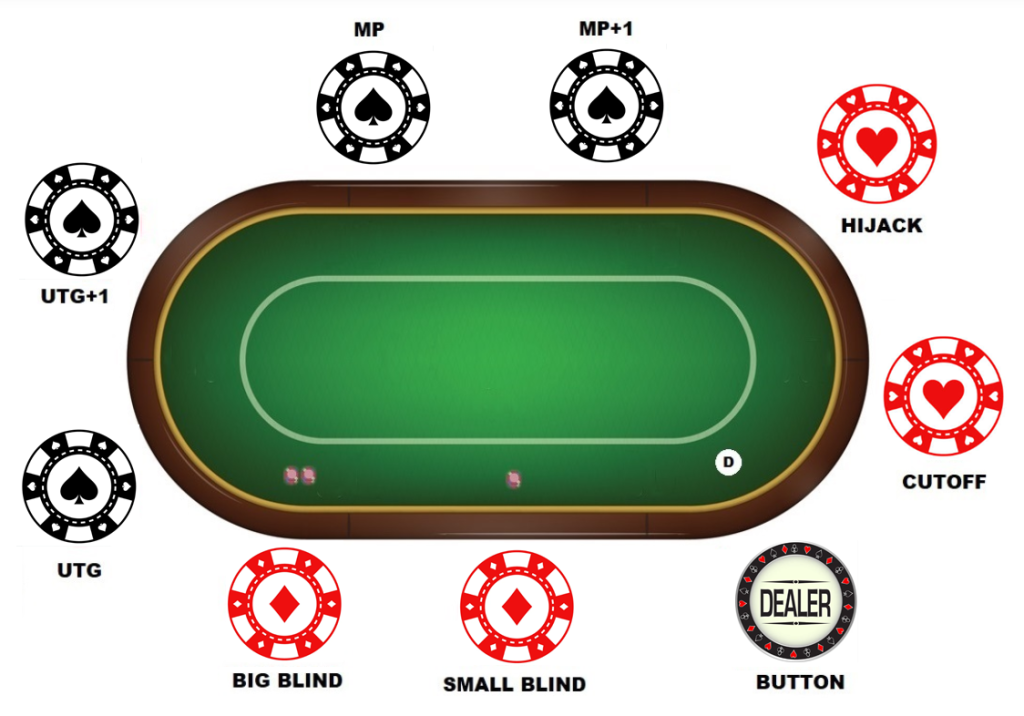
Among the early positions is the Small Blind, which is the first player to make the first mandatory bet that occurs after the flop (the three face-up cards on the table). There is also the Big Blind, which is the player who makes the second mandatory bet, which establishes the minimum bet size.
Average positions
Among the middle positions is the UTG (Under The Gun), which is immediately after the big blind. This position starts the game without much information about the opponents. It is the earliest position, which means that the player can act first after the blinds. Due to the disadvantage of acting early, this position usually plays only with strong hands.
Then there is the MP (Middle Position), which is the intermediate position between UTG and the button and is the best balanced.
Late positions
As you move towards the final positions, the game becomes more aggressive. Players have more information about their opponents and can adapt their strategies. Among the late positions is the "HiJack" which is the position that is two seats to the right of the dealer button, it is a late position where you can take advantage of acting after many players, it is generally a strong position to try to steal the blinds.
Then there is the "Cutoff," which is the player who acts immediately before the dealer and is in a good position at the table, as he can play a wide range of hands and make aggressive moves. Finally, there is the "Button" dealer, who acts last in each betting round, which gives him the most information possible, giving him the most advantageous position at the table.
Advantages and disadvantages of the positions
The most outstanding advantage of the blinds, or early positions, is that they are positions that can be exploited by players in late positions if they show too much strength. However, they are the most difficult positions to play, since players have no information about their opponents' hands.
In the case of middle positions, they have the advantage that they offer a balance between information and pressure. Players can steal pots and build big hands, but they have the disadvantage that they can be exploited by players in late positions if they show weakness.
Late positions are the best positions, as players have the most information and can make more informed decisions, while their disadvantage is that they can be exploited if they show too much strength and opponents decide to pay to see the showdown.
What do you think about this topic? Would you like to know more about the positions at a poker table?
If you want to find the best platform or room to play poker online, you can contact us by visiting the following link.