

A winning session can make the next limit look affordable. One rough evening can make the same game feel too expensive. A bankroll plan gives you a decision before either feeling takes over: how much to set aside, what each entry costs, and when to step down.
Poker bankroll management means keeping a separate poker fund and choosing stakes that fit it. It cannot turn a losing strategy into a winning one. What it can do is limit how much a bad run disrupts your play—and keep money for everyday life out of the game.
The short version
- Keep poker money separate from bills, savings and emergency funds.
- Measure cash games in full buy-ins and tournaments in total entry costs, including fees and re-entries.
- Set your move-down point before you play; do not raise the stakes to recover losses.
- Count rewards only after they are credited and usable. No bankroll size guarantees safety.
What counts as your poker bankroll?
Your bankroll is the money you have deliberately allocated to poker and can afford to lose. It can be split between a poker account and a separate reserve, but it is still one fund. A credit card limit, next month’s salary or money needed for rent is not part of it.
For an occasional player, a fixed entertainment budget may be more useful than a plan to “build a roll.” Decide the amount and time you are comfortable spending, and stop when either limit is reached. You do not need to keep depositing to maintain a particular number of buy-ins.
A working bankroll also differs from the amount left in the cashier. If $300 sits online and $200 is genuinely reserved for poker elsewhere, the total fund is $500. If that $200 is earmarked for groceries, the bankroll is $300. Count each dollar once.
How many buy-ins do you need?
There is no universal safe number. Your format, field size, results after fees, ability to move down and comfort with losses all matter. Bigger tournament fields and faster structures can produce longer gaps between meaningful cashes. A player who relies on withdrawals for expenses also needs a different plan from someone playing occasionally.
Bankroll methods vary with the format and the size of the cushion you need. A 25-buy-in cash framework is relatively aggressive and applies to a specific full-ring strategy. A standard comparison uses 40 cash buy-ins or 100 MTT entries. A more conservative online approach uses 100+ cash buy-ins or 150–300 regular MTT entries. These are planning references with different assumptions, not promises of safety.
| Planning approach | Format | Buy-in comparison | Scope and limits |
|---|---|---|---|
| Aggressive, strategy-specific | 100bb full-ring NL Hold’em cash | 25 full buy-ins | A specific strategy framework, not a universal rule for every online game. |
| Standard comparison | Cash / multi-table tournaments | Around 40 cash / 100 MTT entries | A planning comparison; ability, expenses and variance still matter. |
| Conservative online approach | Online NL cash / regular online MTTs | 100+ cash / 150–300 MTT entries | The conservative examples in our calculator use 100 and 300. Turbo, hyper and other formats need separate assessment. |
Try the bankroll planner
Start with one number: the money reserved for poker. The calculator automatically compares cash levels and MTT entry ceilings under three clearly labeled plans. Player profiles appear in the results, not as extra required inputs. If you want to check a specific game, open the optional advanced section for a full buy-in and target count. All cash levels assume 100bb stacks; no balance can reveal your ability or make a game safe.
ONE AMOUNT. COMPARE THE PLANS.
Enter the money you have set aside for poker and can afford to lose. The results compare published bankroll approaches; your balance cannot tell us your skill level.
Decimals accepted: 100.50 or 100,50. Keep bills, savings and emergency money outside this amount.
| Plan in the results | Cash · full 100bb stack | Regular MTT · full entry |
|---|---|---|
| Learning / conservative100 cash buy-ins / 300 MTT entries | No listed level fitsThe grid starts at NL2 ($2 stack). Use play money or pause if no suitable lower game exists. | At most $0.33Per entry, including the fee; rounded down. |
| Regular with tracked results40 cash buy-ins / 100 MTT entries | Up to NL2$0.01 / $0.02 blinds · $2.00 stack · 50 buy-ins available | At most $1.00Per entry, including the fee; rounded down. |
| Income-dependent / professional100 cash buy-ins / 300 MTT entries | No listed level fitsThe grid starts at NL2 ($2 stack). Use play money or pause if no suitable lower game exists. | At most $0.33Per entry, including the fee; rounded down. |
These are price ceilings under each plan, not room availability or permission to play. Re-entries cost another full entry. If no suitable game exists at or below a ceiling, use free play or pause. Never deposit just to meet a displayed amount.
How to read the plans
An illustration using a larger cushion while results are uncertain. Start with play money or the smallest games, even if more expensive stakes fit the arithmetic.
Conservative comparison: 100 full cash buy-ins or 300 regular MTT entries.A comparison using a smaller planning cushion. It assumes you can step down and keep living expenses separate; it does not establish that you beat the game.
Standard comparison: 40 full cash buy-ins or 100 regular MTT entries.Professionals do not automatically need fewer buy-ins. Withdrawals and dependence on results can require a larger reserve, plus living expenses kept outside the bankroll.
Conservative comparison: 100 full cash buy-ins or 300 regular MTT entries.These profiles describe planning scenarios, not an assessment of your ability. The professional plan illustrates a larger cushion, not a complete professional funding model. Rake, variance, withdrawals and living reserves require separate assessment. The cash example grid ends at NL200 and does not list every available stake.
Check a specific game — advanced options
Optional: enter a full buy-in and compare it with a chosen buy-in count. Defaults use the more conservative published examples: 100 for cash, 300 for MTT. This does not change the plans above.
A $0.10 big blind means a $10 stack at 100bb. It is not a $0.10 buy-in. For deeper stacks, enter the entire stack cost.
A 25-buy-in cash framework is relatively aggressive and strategy-specific. The standard comparison uses 40 cash buy-ins or 100 MTT entries; the conservative comparison uses 100 cash buy-ins or 300 MTT entries. Different formats and consequences of losses call for different cushions. The lowest number is not a safety guarantee.
Cash calculations assume 100bb stacks; MTT figures refer to regular events. They do not cover PLO, hyper-turbos or jackpot formats. If you are chasing losses or cannot stick to your limits, stop. Responsible play and support.
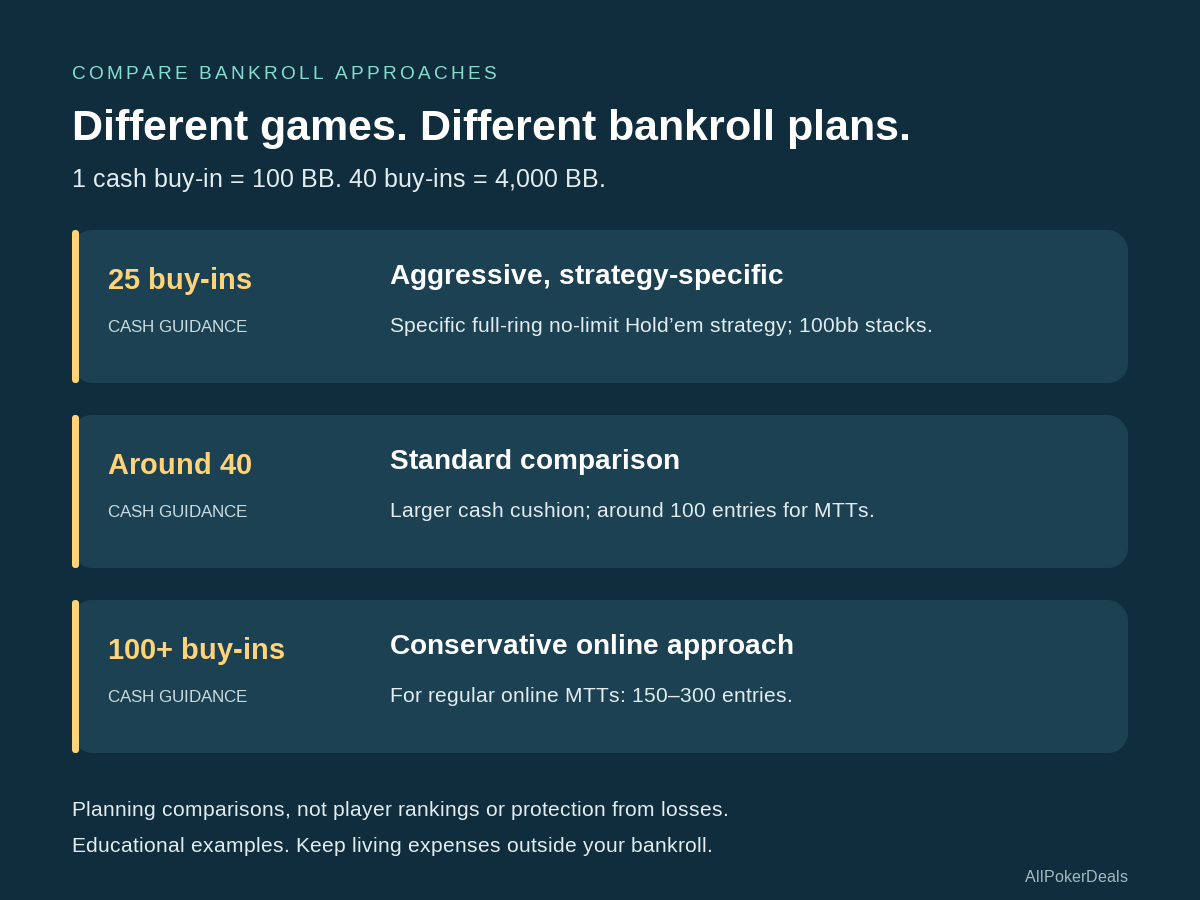
- 25 buy-ins · Aggressive frameworkA specific full-ring 100bb strategy framework. Not a universal minimum.
- 40 buy-ins · Standard comparisonCash guidance with a larger cushion; around 100 entries for MTTs.
- 100+ buy-ins · Conservative approachFor regular online MTTs, compare a larger cushion of 150–300 entries.
These approaches use different cushions and assumptions. One 100bb cash stack is one buy-in. This educational comparison is not a personal risk estimate and does not change with your inputs.
Download the infographic (PNG) ↓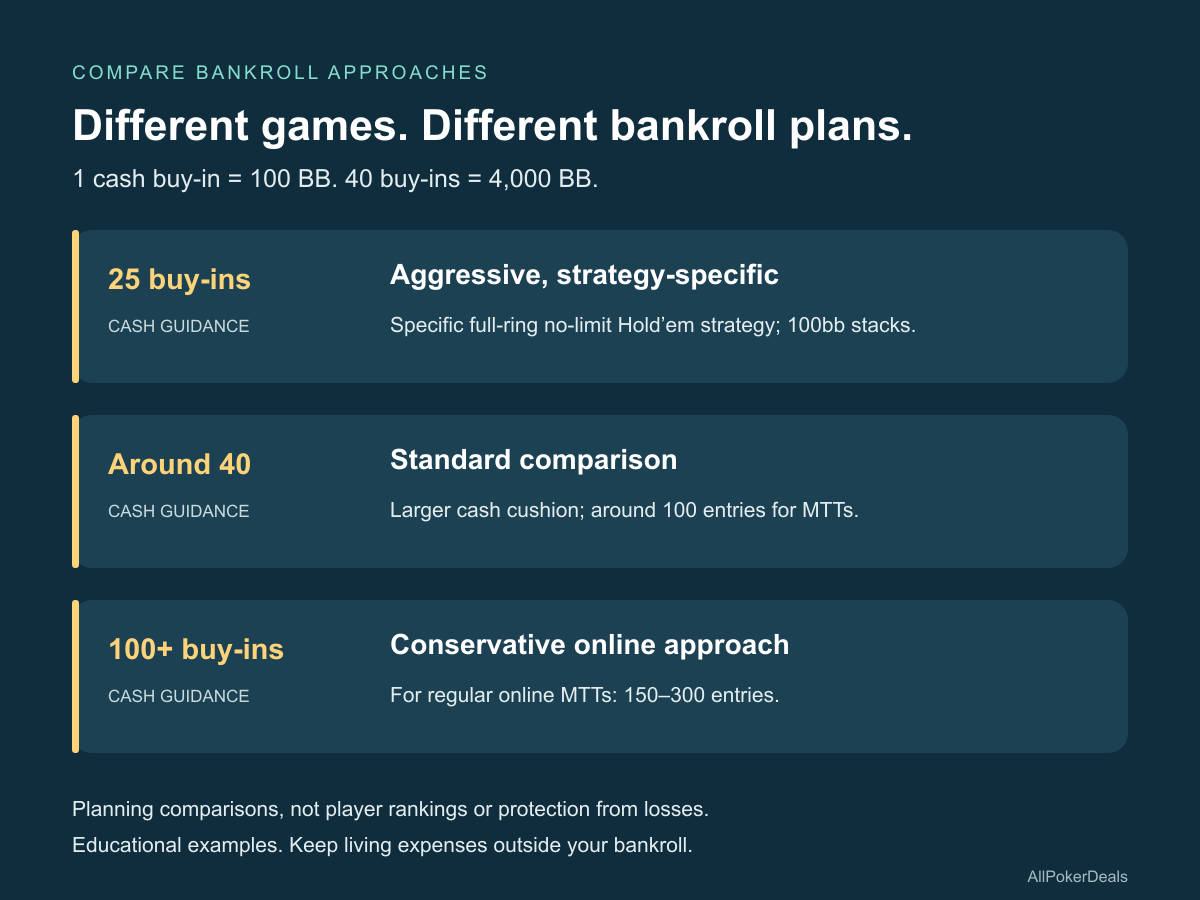
A QUICK CHECK BEFORE YOU PLAY
0 of 5 planning checks completed. This is a reminder, not clearance to play. Your entries stay on this page and reset when you reload.
Download a blank session log (CSV) ↓Cash games: calculate the full stack first
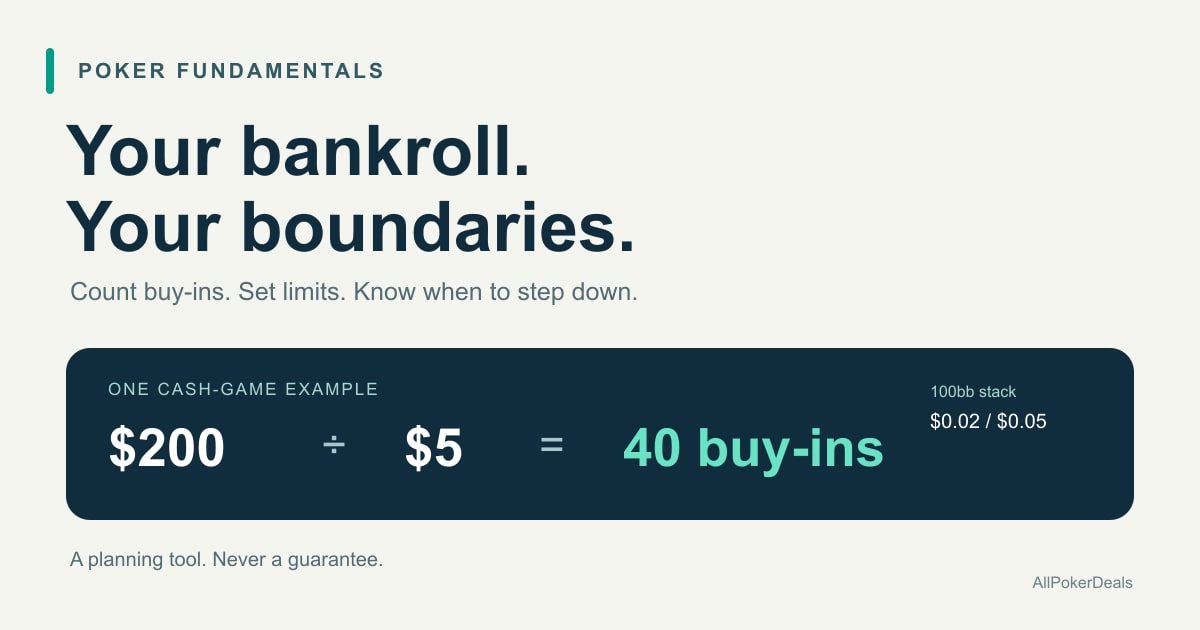
In a $0.02/$0.05 cash game, the big blind is $0.05. A 100-big-blind stack costs $5. A $200 bankroll therefore contains 40 full $5 buy-ins. The blind amount alone is not the cost of buying in.
- Full buy-in
- Big blind × stack in bb $0.05 × 100 = $5
- Buy-ins available
- Bankroll ÷ full buy-in $200 ÷ $5 = 40
- Planning amount
- Full buy-in × target count $5 × 50 = $250
A deeper stack changes the calculation. Buying in for 200bb at the same blinds costs $10, so $200 covers 20 of those entries, not 40. Short buying does not automatically make an otherwise unsuitable game a good choice; the strategy and practical costs change too.
Multitabling increases the amount in play at once. Four tables with $5 stacks put $20 on the tables. That is not a separate bankroll for each table: it is exposure from the same fund. Include reloads when deciding how much of it you are willing to use in one session.
Tournaments: include fees, re-entries and the whole schedule
For tournaments, use the complete price of an entry. If the lobby shows $4.50 + $0.50, each entry costs $5. A second bullet makes the event cost $10 before any add-on. A ticket has entry value, but it is not automatically withdrawable cash.
Average buy-in, often shortened to ABI, is total entry spending divided by the number of entries. It describes your schedule; it does not make every expensive event affordable. Two players can have the same ABI while one takes much larger individual risks.
| Event | Entries | Cost per entry | Total paid |
|---|---|---|---|
| Regular MTT | 2 | $5 | $10 |
| Evening MTT | 1 | $3 | $3 |
| Turbo | 1 | $2 | $2 |
| Session total | 4 | ABI: $3.75 | $15 |
With a $300 bankroll, this $15 schedule uses 5% of the fund in entry costs. That percentage describes the exposure; it does not prove the schedule is suitable. A long tournament session also commits time, so a money limit and a latest registration time belong in the same plan.
Large-field events can pay most of their money to a small group of finishers. Do not treat a recent final table as evidence that the next month will finance a higher ABI. Review the number of entries, field sizes and results after fees over a meaningful sample.
When to move down—and when to consider moving up
Choose a published planning approach before the session, and keep it consistent. The table compares a 40-buy-in approach with a 100-buy-in approach for the same 100bb cash stacks. If your remaining fund no longer supports a level under the approach you chose, move down or pause; do not lower the target to justify continuing.
| Cash level | 100bb full buy-in | 40-buy-in comparison | 100-buy-in comparison |
|---|---|---|---|
| NL2 · $0.01/$0.02 | $2 | $80 | $200 |
| NL5 · $0.02/$0.05 | $5 | $200 | $500 |
| NL10 · $0.05/$0.10 | $10 | $400 | $1,000 |
| NL25 · $0.10/$0.25 | $25 | $1,000 | $2,500 |
For example, a 100-buy-in approach requires $1,000 for a $10 NL10 stack. If the fund falls below that amount, the same plan no longer supports NL10. NL5 needs $500 under that approach. Reaching a threshold makes a level fit a budget calculation; it does not prove you have the skill or confidence to play it.
Do not interpret a professional label as permission to use fewer buy-ins. An established player may have a better measured edge, but withdrawals and dependence on winnings increase the consequences of a downswing. A beginner should start with play money or the smallest games even if a large balance would mathematically support higher stakes. Living expenses and emergency reserves belong outside the playing bankroll.
Downswings, stop-losses and the point to stop playing
Variance is the gap between the results you expected and the results you actually get over a sample. You can make a good decision and lose the hand. But not every loss is variance: weak decisions, rake, poor table selection and tilt can all contribute.
A session stop-loss can limit spending and make it easier to stop when concentration slips. It does not alter the cards or guarantee a better next session. Decide both a money limit and a time limit, and end the session sooner if you start chasing, changing your rules or using money you had not allocated.
A useful response to losses
- Follow the move-down rule already written in your plan.
- Review hands later, away from the pressure of the session.
- Check net results after fees and separate mistakes from uncertain outcomes.
A plan that is breaking down
- Moving up because a larger win would recover the loss.
- Adding unplanned deposits or extra tournament bullets.
- Extending the session until the balance returns to its starting point.
If you cannot keep to your limits, stop playing rather than search for a better bankroll formula. Use the room’s deposit, spending or time controls where available. GamCare’s money guidance explains how to separate essential spending from gambling; its services are based in Great Britain, and support options elsewhere depend on location.
Rakeback, bonuses and withdrawals: use cleared money
Rakeback can reduce your net playing cost. It does not remove variance or justify a higher stake on the strength of an advertised percentage. Calculate your playing plan from funds already available, not a bonus you hope to unlock.
Here is a simple ledger: a $300 starting fund, $50 lost at the tables after rake, and $20 in credited cashback leaves $270. Withdrawing $40 leaves $230 available for poker. A further $30 locked bonus is not included. Do not subtract the same rake twice if your table result already includes it.
| Movement | Amount | Available bankroll |
|---|---|---|
| Opening bankroll | — | $300 |
| Table result after rake | −$50 | $250 |
| Credited cashback | +$20 | $270 |
| Withdrawal | −$40 | $230 |
| Locked or pending bonus | $30 pending | $230: unchanged |
A withdrawal is a real reduction in the playing fund. Check your stake thresholds after taking money out. Keeping a separate buffer for expenses also avoids treating the cashier as a promise of next month’s income.
Before valuing an offer, read what rakeback means and how to read rakeback terms. Compare credited value, restrictions and game eligibility—not just the headline rate.
A bankroll log you can actually maintain
Use one currency for your record. At a minimum, log the date, format, stakes, entries or hands, money added, withdrawals, rewards and the closing balance. Separate deposits from playing results so a fresh deposit does not look like profit.
Reconcile the record with your cashier history regularly. Keep restricted tickets and locked rewards in a separate column. If you hold poker funds in a volatile currency, their value in the currency used for your budget can change even without playing a hand.
Before your next session
- My poker fund is separate from essential spending.
- I know the full cost of each stack or entry and my maximum reloads.
- I have written down the move-down balance, session spending limit and finishing time.
- Pending rewards are excluded from the balance I am using.
- I will stop if I start chasing losses or breaking the plan.
Poker bankroll management FAQ
Is 20 buy-ins enough for cash games?
Twenty buy-ins is a small cushion, below the 25-, 40- and 100-buy-in cash comparisons shown here. No count guarantees protection. The appropriate plan depends on the game, results and consequences of losses; a losing strategy cannot be repaired by adding more entries.
What stakes can I play with $100?
At a $2 full buy-in, $100 represents 50 entries. At a $5 buy-in it represents 20. That arithmetic helps compare exposure, but it does not establish that either game is right for you. Play money is an option if the smallest available game does not fit your budget.
Does a larger bankroll make me profitable?
No. A larger fund gives you more entries, not a strategic advantage. If your expected result after costs is negative, bankroll management cannot reverse it. Study, game selection and honest results tracking address different problems from funding.
Can I use expected rakeback to move up?
Do not count pending rewards as available bankroll. Once cashback is credited and usable, record it in the balance and reassess your plan. Eligibility, caps and release conditions can make the credited amount different from an estimate.
Should I refill the bankroll after a downswing?
An extra deposit is not a required step in bankroll management. If a loss reaches your pre-agreed budget, stop. Any later decision to allocate more must fit a fresh, affordable entertainment budget and must not be an attempt to chase losses.
Method and limitations
Reviewed on 18 October 2026. Calculations and example schedules use full 100bb cash stacks or complete tournament entries, including fees. The planning scenarios illustrate different cushions; they are not a standardized ranking of player ability or a personal risk-of-ruin model. Dollar amounts are illustrative USD values. Rake, game format, results, withdrawals and living expenses require separate assessment.
GamCare: managing your money — budgeting and keeping essential expenditure separate from gambling.
For the next step, compare the practical differences between cash games and tournaments.
Put this guide into practice
- Calculate full cash buy-ins and all-in tournament entry costs.
- Set a move-down rule without counting pending rewards.
- Use one bankroll amount to compare published plans, with optional checks for a specific game.