

A cash table and a tournament can deal the same cards and still ask very different things of you. One lets you build a session around your own clock. The other gives you a place in an event whose structure keeps moving. Before comparing a buy-in or a promotion, understand what you are buying: a stack with cash value, or an entry into a competition.
The main difference is how the chips work. In standard cash games, they represent money at the table’s stated value. In a tournament, chips measure your position in the event; you cannot normally exchange your remaining stack for its face value. Time, costs and strategy follow from that distinction.
The short version
- Cash: monetary chips, fixed table stakes and flexible stopping points.
- Tournaments: an entry cost, rising blind levels and payouts defined by the event.
- Compare the full cost and time commitment, not just the headline buy-in.
- Neither format is automatically easier, more profitable or suitable for your budget.
Cash games vs tournaments at a glance
| What changes | Cash games | Tournaments |
|---|---|---|
| Chips | Represent money at a fixed table value. | Tournament units, not a cash-out balance. |
| Entry cost | A stack within the table’s minimum and maximum. | An entry with its stated fee; further entries cost extra. |
| Blinds | Stay at the table’s advertised stake. | Usually increase according to the structure. |
| Leaving | Finish the hand and leave under the table rules. | Sitting out does not normally freeze your stack or the event. |
| Prize | The value of your remaining cash stack. | Payouts follow the event’s rules and prize structure. |
| Reloading | Subject to table limits and your own spending cap. | Only if the event permits re-entry, rebuys or add-ons. |
| Main planning question | What full stack and session budget fit my plan? | What total entry cost and duration can I commit to? |
This guide focuses on conventional online no-limit Hold’em cash and multi-table tournaments (MTTs). Cash-out tournaments, satellites, bounty events and other special formats can change the details. Read the specific lobby and rules before entering.
How cash games work: your stack has a money value
At a $0.05/$0.10 table, the small blind is $0.05 and the big blind is $0.10. A 100-big-blind stack costs $10. A $0.10 big blind is therefore not a $0.10 buy-in. Some tables allow different stack sizes, so check the permitted range rather than assuming every table uses 100 BB.
If you buy in for $10 and leave with $12.40, the table result is +$2.40, assuming no other buy-ins or separate costs. If you reload, include that money too. Your ending stack alone is not your session profit.
Cash lets you choose when to stop after completing the current hand. That flexibility helps with a fixed schedule, but it does not make the game stable or prevent a large swing. Multitabling, deeper stacks and repeated reloads can increase the money in play quickly.
How tournaments work: an entry buys a place in the event
An MTT combines players across several tables and awards prizes under a published structure. Tables are balanced or closed as the field becomes smaller. In a conventional freezeout, being eliminated ends that entry. Re-entry events allow another paid attempt only within their stated rules and registration window.
A $4.50 + $0.50 entry costs $5: $4.50 goes to the prize pool and $0.50 is the stated fee in this example. A second entry makes the total spend $10. Not every lobby displays fees in the same way; open the breakdown and check bounty or add-on components where relevant.
Your tournament stack is not a withdrawal amount. In a standard MTT, having 30,000 chips does not mean having $30,000, and doubling the stack does not automatically double your prize equity. The payout structure, remaining players and stack distribution all matter.
Why blind levels change the same stack
Measure playing depth in big blinds: divide your chip count by the current big blind. A tournament stack can become shallower even if its chip count stays the same. That changes how much room there is for raises, calls and post-flop decisions.
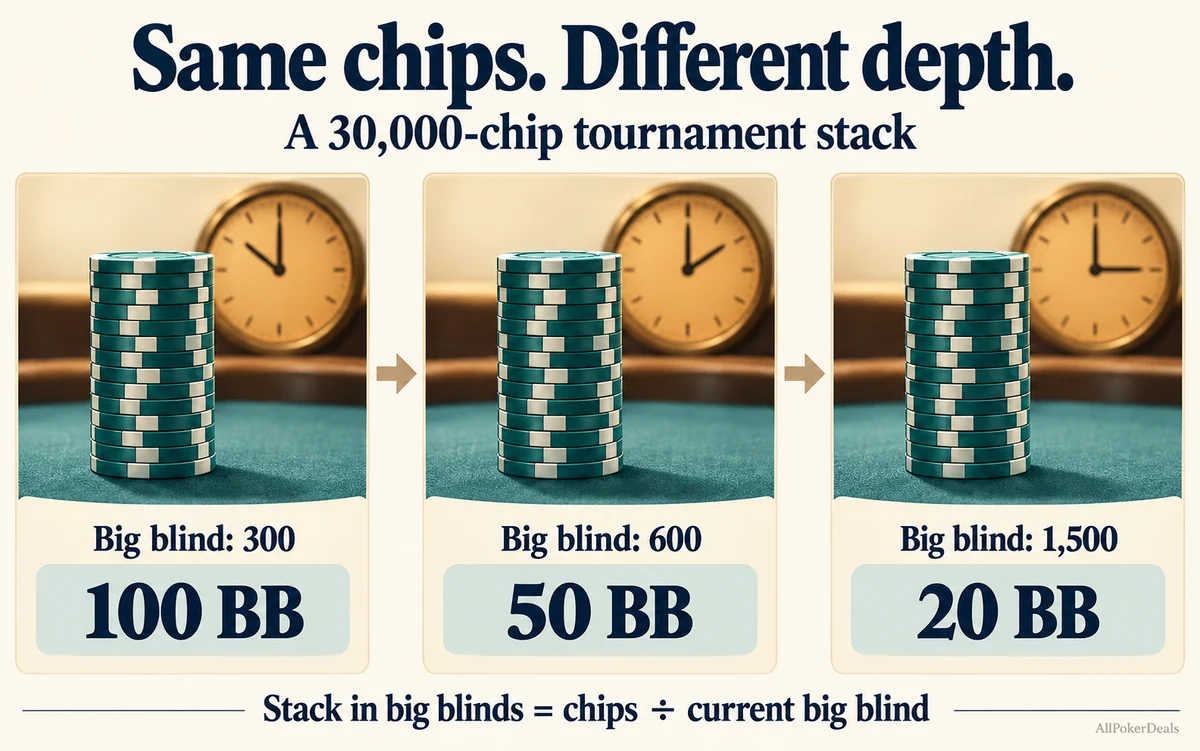
| Chips | Current big blind | Stack depth |
|---|---|---|
| 30,000 | 300 | 100 BB |
| 30,000 | 600 | 50 BB |
| 30,000 | 1,500 | 20 BB |
These are example levels, not a promise of a particular tournament schedule. In a standard cash game, the table’s blinds do not rise with a tournament clock, although your own stack can grow or shrink from hand to hand.
Session length: choose a format that fits your time
If you have a firm stopping time, cash generally offers more control over the end of your session. A tournament’s advertised start time tells you when it begins, not when you will finish. Late registration, field size, blind speed and the number of starting chips all affect the event’s progression.
You can usually sit out of a tournament, but blinds and antes continue to be posted when due. It is not the same as cashing out. Faster structures do not guarantee that a tournament will fit a short break, and some events have no scheduled breaks.

Strategy: stack depth and payouts change decisions
Both formats reward sound decisions about position, ranges, bet sizes and opponents. The distinction is not “cash is patient, tournaments are aggressive.” A good decision depends on the actual situation, not a slogan about the format.
In cash, monetary expected value after costs is central. At deeper stacks, mistakes in large post-flop pots can be especially expensive. In tournaments, effective stacks may move from deep to short as blinds rise, and the payout structure can change the value of taking a marginal chip advantage.
Near a payout threshold or a final table, ICM—the Independent Chip Model—offers a way to relate stacks to shares of the remaining prizes. It helps explain why a call that gains chips may still be unattractive in prize-money terms. It is a model, not a complete strategy: player skill, future play and special payout formats can matter beyond its assumptions.
That does not mean folding everything to reach the money. Nor does a short stack mean moving all-in with any hand. Study the ranges and decisions appropriate to the effective stack, position and event structure.
Costs and bankroll: compare complete entries
| Example | Cash | Tournament |
|---|---|---|
| What the price means | $0.05/$0.10 are blinds; a 100 BB stack is $10. | $4.50 + $0.50 is a complete $5 entry. |
| An additional attempt | A $10 reload adds $10 to session spending. | A second $5 entry makes the event cost $10. |
| Playing fee | Typically rake under the table’s rate and cap. | Typically the entry fee shown in the lobby. |
| Before comparing rewards | Check rake, caps, eligible games and actual credited value. | Check fees, re-entry rules and reward eligibility. |
These are arithmetic examples, not recommended stakes or universal fee schedules. Additional charges and special formats can apply. Do not subtract rake twice when a recorded table result already includes it.
Large-field MTTs often concentrate returns in infrequent deep finishes, so their results can be uneven across many entries. Cash also has substantial variance. Being able to leave a table does not remove it, and a short winning session does not establish a sustainable edge.
Use a separate poker fund and compare full buy-ins with our bankroll management guide and calculator. Keep living expenses and emergency savings outside that fund; never add entries just to recover a previous result.
For a clearer view of playing costs, start with what rakeback means. Compare the actual rules and credited amounts rather than choosing a format for an advertised percentage alone.
Choose a format around your session
| Your priority | What to explore | What to check first |
|---|---|---|
| A fixed finishing time | Cash may offer more control over stopping. | Your session cap, full stack cost and table exit rules. |
| A structured competitive event | A tournament with a suitable structure. | Possible duration, breaks, entry fees and re-entry limits. |
| Learning with repeatable conditions | One cash stake or a consistent tournament format. | Comparable stack depths and a manageable study plan. |
| Trying poker for the first time | Play-money games and rules practice. | Whether the rules and spending controls are clear. |
You do not have to specialize immediately. Try the rules in free play, then review whether the format fits your schedule and budget before considering real-money play. Neither a table match nor a promotion is a reason to exceed your limits.
Before joining a table or registering
- I know whether the displayed price is a blind, a full stack or a complete entry.
- I have checked fees, reloads, re-entries and any extra charges.
- My stopping time fits the format, including a possible tournament run.
- My total spending limit is separate from essential money.
- I know where to find the room’s spending controls and responsible-play support.
Cash games vs tournaments FAQ
Is cash or tournament poker better for beginners?
Neither format is automatically easier. Cash offers fixed table stakes and more control over when to stop; tournaments add changing blind levels and event-specific payouts. Start with free play, learn the full cost and choose a format whose structure you understand.
Can I cash out my tournament chips?
Not at face value in a standard tournament. Prizes follow the event rules. Some special cash-out formats offer different mechanisms, so check the specific event rather than applying cash-table rules.
Does a $10 cash stack equal a $10 tournament entry?
They can cost the same initially but buy different things. The cash stack has a money value at the table; the tournament entry buys participation under a prize structure. Fees, duration and the cost of further attempts can differ.
What happens if I leave a tournament early?
Sitting out usually leaves your entry active while required blinds and antes continue. It does not normally pause the tournament or convert the stack to cash. Check the event rules, including any special cash-out or cancellation provisions.
Do tournaments always require more bankroll than cash?
A large-field tournament schedule can call for a larger cushion measured in entries, but no single ratio applies to every format or player. Compare the full entry price, field size, structure and consequences of spending the fund. Use a bankroll plan suited to the game rather than a universal buy-in count.
Is one format more profitable?
Profitability depends on your decisions, opponents, fees and results across a meaningful sample. Neither flexible sessions nor the possibility of a large tournament prize establishes an edge. Track cash results after rake and tournament results after all entries and fees.
How to use this comparison
Reviewed on 19 October 2026. Examples use USD and conventional no-limit Hold’em cash or regular MTT structures. They illustrate calculations, not a room’s current prices, a personal bankroll recommendation or a guarantee of results. Special events can differ; the lobby and current rules determine the actual terms.
If sticking to spending or time limits becomes difficult, pause and use our responsible-play information and support.
Put this guide into practice
- Distinguish a cash stack from a tournament entry and its fees.
- Calculate stack depth in big blinds as tournament levels change.
- Compare session time, costs and format-specific decisions before choosing a room.