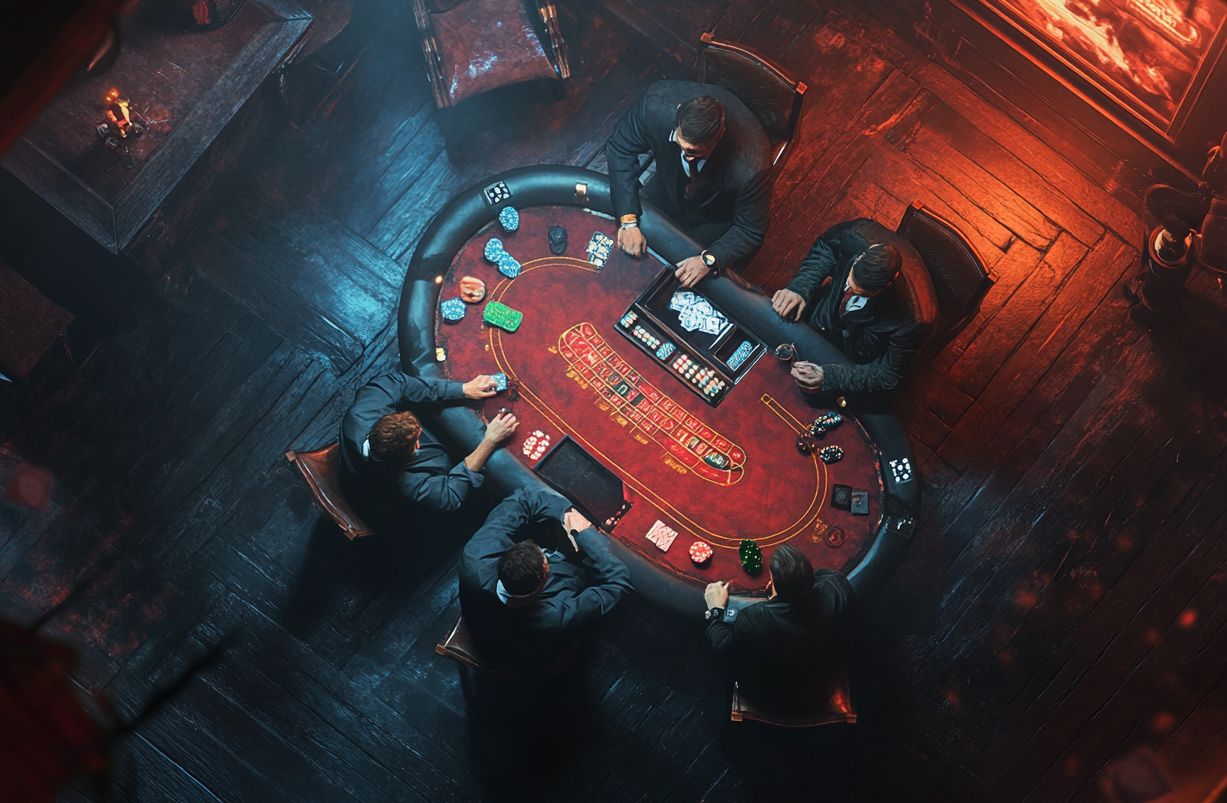
Position in poker is your seat relative to the dealer button, and it decides when you act in every betting round. Acting later means seeing what others do before you choose, which is why the same hand can be a raise on the button and a fold under the gun.
Poker positions in 30 seconds
- The button (BTN) is the best seat: it acts last on the flop, turn and river.
- Early positions (UTG) act first before the flop, so they play the tightest ranges.
- The small and big blinds post forced bets and act first after the flop.
- Open more hands as you move from UTG towards the button.
- Position names change slightly between 6-max and 9-max tables.
What is position in poker?
Every hand, the dealer button moves one seat clockwise. The two players to its left post the small blind and big blind. Everyone else is named by their distance from the button.
Position matters because poker is a game of incomplete information. The later you act, the more decisions you have already seen, and the easier it is to control the size of the pot.
Poker position names and order
Poker table positions (9-max)
Seats in preflop acting order. After the flop, the order starts with the small blind and ends with the button.
| Position | Abbreviation | Group | Acts preflop | Acts postflop |
|---|---|---|---|---|
| Under the Gun | UTG | Early | 1st | 3rd |
| Under the Gun +1 | UTG+1 | Early | 2nd | 4th |
| Under the Gun +2 / Middle | UTG+2 / MP | Middle | 3rd | 5th |
| Lojack | LJ | Middle | 4th | 6th |
| Hijack | HJ | Late | 5th | 7th |
| Cutoff | CO | Late | 6th | 8th |
| Button (dealer) | BTN | Late | 7th | Last |
| Small blind | SB | Blinds | 8th | 1st |
| Big blind | BB | Blinds | Last | 2nd |
6-max vs 9-max tables
Online cash games are often six-handed. The early and middle seats disappear, so the first seat to act is still called UTG (sometimes lojack).
| 6-max seat | Equivalent at 9-max | What changes |
|---|---|---|
| UTG / LJ | Lojack | Fewer players behind, so you can open more hands than 9-max UTG. |
| Hijack (HJ) | Hijack | Two seats from the button; a common stealing seat. |
| Cutoff (CO) | Cutoff | Second-best seat; open a wide range. |
| Button (BTN) | Button | Best seat; widest opening range. |
| SB and BB | Blinds | Same forced bets; you defend more often against wide opens. |
Why position matters
What acting last gives you
You see checks, bets and raises from players who act before you.
You decide whether to keep the pot small or build it with strong hands.
Late seats can raise to win the blinds when earlier players fold.
Fewer guesses mean fewer costly mistakes on the turn and river.
Early position: UTG and UTG+1
Early players act first before the flop with many opponents still to act. Play a tight, strong range: big pairs, strong aces and the best broadway hands. Read the full guide to early positions at a poker table.
Middle position: MP and lojack
Middle seats can add more pairs, suited broadways and suited aces, but several players still act behind you. See our guide to middle positions for hand examples.
Late position: hijack, cutoff and button
Late seats are where most profit comes from. The cutoff and especially the button can open a wide range and apply pressure, because only the blinds act after them before the flop and they keep position after it. Learn the details of playing the dealer button.
The blinds: small blind and big blind
The blinds put money in before seeing cards and act first after the flop, so they are the hardest seats to play profitably. The big blind closes the preflop action and gets a discount to call, so it defends more hands. More in our guide to big blind and small blind positions.
How many hands to open from each position
Illustrative opening ranges (6-max cash, 100 big blinds)
Starting points when everyone has folded to you. Adjust for opponents, stack sizes and table dynamics.
| Position | Approx. range | Example hands that are usually opens |
|---|---|---|
| UTG | 15–18% | 77+, ATs+, KJs+, QJs, AQo+ |
| Hijack | 19–22% | 55+, A9s+, KTs+, JTs, AJo+, KQo |
| Cutoff | 26–30% | 22+, A2s+, K9s+, T9s, ATo+, KJo+ |
| Button | 40–50% | Any pair, most suited hands, A2o+, K9o+, QTo+ |
| Small blind | 30–45% | Raise-or-fold strategy with a range close to the cutoff |
These figures are illustrative, not a rule. For more on hand selection, read our guide to starting hands.
Acting order before and after the flop
Preflop
- UTG acts first.
- Action moves clockwise to the button.
- Small blind, then big blind act last.
Flop, turn and river
- Small blind acts first (if still in the hand).
- Big blind, then the earlier seats follow.
- The button acts last.
Common position mistakes
Avoid these
- Opening the same hands from UTG and from the button.
- Calling too often out of position after the flop.
- Defending the small blind as if it were the big blind.
- Ignoring who is in the blinds when deciding to steal.
- Forgetting that 6-max and 9-max ranges are different.
Frequently asked questions
What is the best position in poker?
The button. It acts last on every street after the flop, which gives the most information and control.
What is the worst position in poker?
The small blind is usually the hardest to play: it posts money blind and acts first after the flop. Under the gun is the toughest seat before the flop.
What do UTG, HJ, CO and BTN mean?
Under the gun, hijack, cutoff and button. They describe seats from the first to act before the flop up to the dealer button.
Does position matter in tournaments?
Yes. It matters even more as stacks get shorter, because late seats can steal the blinds and antes more often.
Keep learning about positions
- Early positions at a poker table
- Middle positions at a poker table
- Big blind and small blind
- The dealer button: advantages and disadvantages
- Advantages and disadvantages of each position
Ready to put it into practice? Compare rooms and offers in our poker room reviews.