In the world of professional poker, where decisions are measured in milliseconds and mistakes cost thousands of dollars, there’s a secret that the best players jealously guard: meditation. Beyond mathematical strategies, meditation has become the “secret weapon” of champions like Fedor Holz and Liv Boeree. In this article, we’ll learn how this practice can improve players’ performance and give them a significant advantage at the table.
The mental battle of poker
In many cases, a poker game can become a psychological battlefield where self-control, concentration, and emotional management determine success. According to studies from the University of Nevada, professional poker players make around 20,000 decisions in a typical 8-hour session. Each of these decisions requires instant probabilistic analysis, reading opponents, bankroll management, and emotional control. In this context, meditation emerges as an effective tool for developing the mental skills essential for high-level poker.
Decisions made at the table can determine a player’s success or failure, and are often influenced by a person’s mental state. For this reason, meditation has become a key tool for poker players looking to improve their performance and stay calm in high-pressure situations.
The connection between mind and success in poker
To excel at poker, it’s not enough to master the rules and strategies of the game. You need to develop the mental strength to handle uncertainty, cope with stress, and prevent emotions from interfering with your decisions.
Meditation helps train the mind, providing clarity and focus. By practicing it regularly, you can increase your ability to remain calm even in the most tense moments of the game. This translates into better decision-making and a more controlled attitude in the face of the game’s ups and downs.
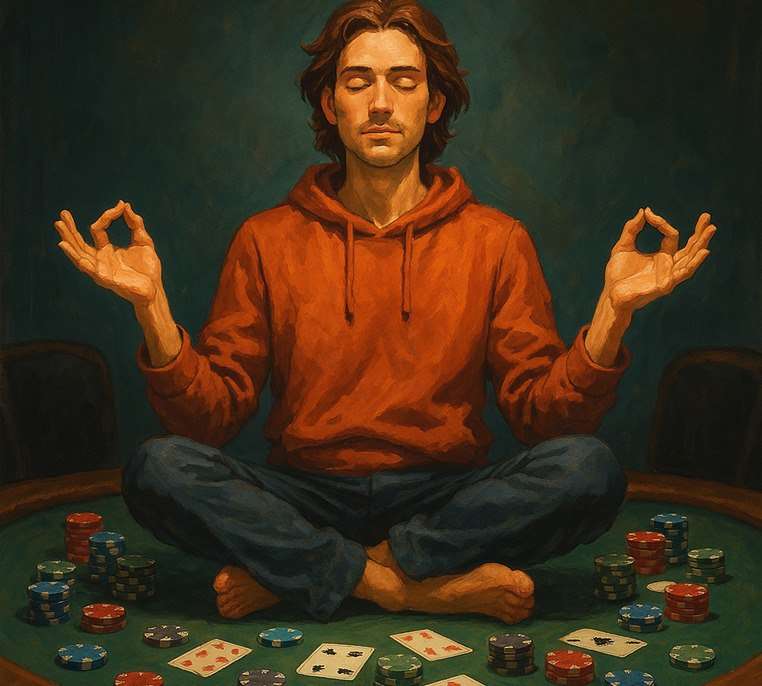
Benefits of meditation for poker players
Meditation offers a wide variety of benefits that can improve gaming performance. Poker can be emotionally draining, especially when the stakes are high. Meditation reduces stress by teaching players to breathe deeply and focus on the present moment. Mindfulness, developed through meditation, allows players to better focus on the table, avoiding external distractions and unnecessary thoughts.
In poker, staying calm in the face of defeat and not getting carried away by the euphoria of victory is essential. Meditation helps control emotions, avoiding impulsive decisions that could harm the game. Since poker players inevitably face ups and downs, meditation helps develop a resilient mindset, allowing them to recover quickly from losses and move forward with determination.
Types of meditation useful for poker players
There are various forms of meditation that can benefit poker players. Some of the most recommended include mindfulness meditation, which focuses on being fully present in the moment, observing one’s thoughts and emotions without judgment. This is especially helpful for preventing negative emotions from influencing gaming decisions.
Guided meditation is ideal for beginners, as it offers step-by-step instructions to help you relax and focus. There are many apps and online resources that offer specific meditations for managing stress. Practicing mindful breathing techniques can also help players calm down quickly, especially during tense in-game situations.
Finally, transcendental meditation, which is a method that involves repeating a “mantra” (a word or sound with no particular meaning) to achieve a state of deep relaxation and mental clarity. The goal of this type of meditation is not to concentrate intensely or force the mind, but rather to allow it to naturally “transcend” into a state of calm and pure awareness, beyond thought.
Scientific benefits of meditation
MIT research has shown that practicing just 10 minutes of meditation a day increases activity in the prefrontal cortex, the area responsible for rational decision-making. This translates into fewer tilt errors, more decisions based on probabilities rather than emotions, and a greater ability to abandon marginal hands.
A WSOP study revealed that 68% of players lose more money due to tilt than due to strategic errors. Meditation decreases activity in the amygdala (fear/anger center), increases tolerance for losing streaks, and helps you stay calm after bad plays.
For its part, the University of California found that regular meditators can maintain attention four times longer than players who don’t meditate. In poker, this means fewer errors due to distraction during long sessions, a greater ability to detect tells, and better monitoring of table dynamics.
Meditation strengthens the “default mode network,” which is responsible for sudden insights. This explains why players like Daniel Negreanu attribute his legendary palm-reading ability to meditation.
An advantage in a competitive game
In the world of poker, where competition is fierce and decisions can change the course of a game, meditation offers a significant advantage. Not only does it improve mental skills, but it also allows players to become more aware and balanced.
More than a spiritual practice, meditation is currently the most underrated mental practice in competitive poker. As the legendary Doyle Brunson said, “Poker is a human game played with cards, but won with the mind,” and nothing trains the mind better than the disciplined practice of meditation.
What do you think about this topic? Want to learn more about poker meditation?
If you want to find the best room to play poker online, you can contact us by visiting the following link.