One of the most important variables that influences a poker player’s success is the position they occupy at the table. Position determines the order in which players act in each betting round, which can provide certain advantages or disadvantages, as it can become a crucial factor that will influence a player’s decision making and success.
Depending on where a player is positioned in relation to the dealer, he or she will have more or less information and control over the development of a hand. In this article, we will learn about the main advantages and disadvantages of the different positions at a poker table.
What are the positions at a poker table?
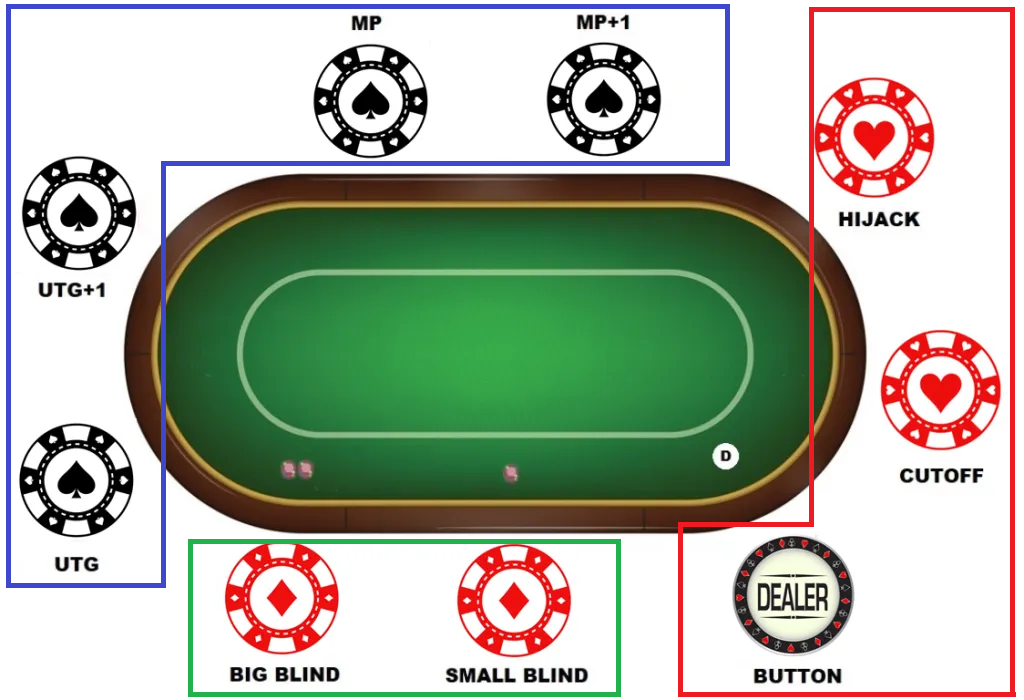
As we saw in our previous article, positions at a poker table are classified into 3 groups:
- Early positions (green zone/box).
- Average positions (violet zone/box).
- Late positions (red zone/box).
Advantages and Disadvantages of Early Positions
The main advantage of the Small Blind is that it only requires half of the minimum bet, which allows you to see the flop at a reduced cost, and you also can steal blinds, since in aggressive play situations the small blind can try to steal the blinds with a strong bet. Among its disadvantages, after the flop, the player in the small blind will be the first to act in each betting round, which limits the information available and, due to the unfavorable position, makes it more difficult to play marginal hands effectively.
In the case of the Big Blind, the competitive advantage is that he is the last to act before the flop, which allows him to see the actions of all the players before deciding, and he can defend his position with a wide range of hands due to the initial investment in the pot. On the negative side, the Big Blind must make a mandatory bet, which can be costly if you don’t have a strong hand. In addition, like the Small Blind, the Big Blind also acts early in the post-flop betting rounds.

Advantages and Disadvantages of Middle Positions
For Under the Gun (UTG), at the advantage level, bets from UTG are often perceived as strong, which can intimidate opponents and players in UTG tend to play more conservatively, selecting strong hands. The negative is that UTG is the first position to act, which means that the player has the least amount of information about the opponents’ hands and due to the lack of information, there is a higher risk of facing stronger hands.
UTG+1 and UTG+2 positions have the advantage that they possess more information than UTG, allowing for more informed decisions and players can play a wider range of hands compared to UTG, giving more information for the game. On the downside, although they have more information than UTG, these positions still act relatively early in the betting round, so there is a moderate risk of facing stronger hands due to position.
Middle Position (MP) has the advantage of offering a good balance between information and the ability to act aggressively, so players in middle position can play a variety of hands and adapt to the actions of their opponents. On the downside, players in late position have more information and can take advantage of the actions of players in middle position, and there is also the risk of facing strong bets from players in late position.
Advantages and Disadvantages of Late Positions
In the case of Hijack (HJ), the advantage is that the player has more information about the opponents’ actions, which allows him to make more informed decisions. This position is ideal for trying to steal the blinds with aggressive bets. The disadvantages are that it is in competition with the Cutoff and the Button, since they have even more information and can counter the Hijack’s actions. There is also the risk of facing a re-raise from players in later positions.
The Cutoff (CO) is one of the strongest positions at the table, with the ability to play a wide range of hands and similar to the Hijack, the Cutoff can try to steal the blinds with aggressive betting. In contrast, the Button has a positional advantage over the Cutoff and can counter his actions. There is also the risk of facing a re-raise from the Button or the blinds.
In the case of the Button (or Dealer), it is the last position to act in each betting round, providing the maximum amount of information. Players on the Button can play a wide range of hands and adapt their strategy based on the actions of their opponents. This position is in control of the game and can dictate the pace of betting. Due to the positional advantage, the Button is expected to play aggressively, which can lead to risky decisions. Players on the Button can overvalue their position and play marginal hands too aggressively.
Define strategies according to the position
Position at a poker table is a crucial factor that can significantly influence a player’s success. Each position has its own advantages and disadvantages, so understanding these differences is essential to developing an effective strategy. Players must adapt their play based on the position they occupy, taking advantage of the advantages and minimizing the disadvantages to maximize their chances of success.
What do you think about this topic? Do you want to know more about poker positions?
If you want to find the best platform to play poker online, you can contact us by visiting the following link.